

The problem with traditional drainage
Traditional drainage systems only evacuate water and don't manage soil behavior over time. Surface grading, sand layers, or deep pipe networks remove excess water without restoring soil structure. The result is that compaction layers remain, oxygen exchange declines, and infiltration becomes inconsistent across the field.
As conditions deteriorate, surfaces require corrective watering, repeated topdressing, and reactive maintenance. Performance becomes harder to predict. Costs rise. Playability narrows to ideal weather windows. Traditional drainage treats visible water. It does not resolve the soil conditions that cause it.

Soil before GEPS®
Stagnant water accumulating on the surface and in underground pockets.
Touch image
Waterlogged surface and unbalanced subsoil
Compacted soil lacks structure and internal balance. Rainwater struggles to infiltrate, leading to surface runoff or localized saturation.
During periods of drought, this same soil contracts, hardens, and loses its capillary permeability.
The subsoil experiences fluctuations in moisture levels, ranging from excess to extreme dryness, causing shrinkage and swelling, cracking, instability, and water stress for plants.


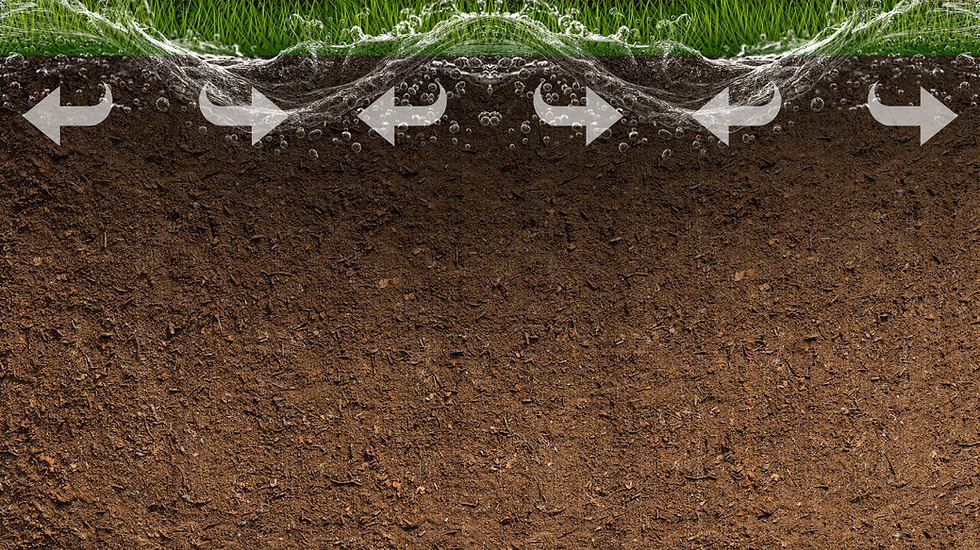
Soil after GEPS®
Water distributed evenly and at depth for a stable and healthy subsoil.
Touch image
Fast-draining surface and stabilized subsoil
The soil regains its porosity and capillary cohesion. Rainwater infiltrates immediately and distributes throughout the soil instead of accumulating or evaporating.
The moisture level stabilizes over the seasons, thus reducing volume fluctuations in the subsoil.
The soil retains water where it is needed, naturally releases excess water, and maintains a homogeneous structure throughout the year.
What GEPS® actually does in the ground
GEPS® is a subsurface soil remediation and water management system developed by Exlterra. Unlike traditional drainage, it does not evacuate water through pipes or voids. Each GEPS® unit is an environmentally-friendly polyethylene section engineered to pull water into the soil using naturally occurring forces.
Water is attracted toward the unit, redistributed vertically between soil layers, and released into less saturated zones below. Rather than forcing water away, the system restores natural moisture movement through the soil profile, improving infiltration while maintaining structural continuity at the surface.
GEPS® units are invisible and installed underground as a calibrated matrix. Their combined radius of influence allows the units to interact, forming a passive system that increases infiltration across the entire surface. Rainwater is absorbed up to ten times faster than with traditional drainage methods.
As excess moisture moves downward, soil pressure equalizes, oxygen exchange improves, and compaction layers release. Where surface compaction is severe, shallow boosters may complement the system to accelerate activation. The result is firm, usable fields year-round and turf watering needs reduced by up to 50%.

Rainwater absorbed 10 times faster*
Firm and usable fields all year round*
Watering needs reduced by 50% or more*
Zero maintenance, zero energy consumption
The only underground system that does three jobs at once. And never needs maintenance.

Why it matters for performance surfaces
Performance depends on consistency. When soil drains unevenly, surfaces alternate between saturation and drought stress. That instability affects traction, rebound, recovery time, and player safety. It also forces aggressive watering and intervention cycles.
GEPS® restores soil function and stabilizes moisture levels across the field. Surfaces clear faster after heavy rain while retaining usable moisture below. Playability extends across a wider range of conditions. This creates measurable improvements in surface response, recovery time, and maintenance efficiency.
Installation overview
Each GEPS® project starts with an on-site field assessment. Soil behavior, compaction depth, usage intensity, and performance objectives are evaluated before any intervention is defined. The installation scope is then calibrated to the field, not standardized.
GEPS® equipment operates below the surface without excavation or turf removal. Installation is fast, targeted, and minimally disruptive. Fields typically return to use quickly, with immediate functional change and progressive improvement over time. The intervention is precise, controlled, and verifiable.


Golf courses
Greens, fairways, tees and bunkers demand precision. GEPS® stabilizes soil moisture, improves root depth, and reduces surface stress for consistent playability, fewer closures, and healthier turf year-round.


Football & soccer fields
Football and soccer destroy weak soil long before it destroys grass. GEPS® reinforces the ground structure and keeps moisture where roots need it. Stronger turf. Faster recovery. Fewer failures during the season.


Baseball fields
Baseball fields rely on consistency across infield, outfield, and base paths. GEPS® stabilizes the soil profile, improves vertical drainage, and preserves oxygen in the root zone. The surface is firmer, more uniform; it recovers faster after rain, and needs fewer maintenance.

Sports complexes
Multiple fields mean multiplied maintenance risk and cost. The GEPS® technology standardizes underground performance across all surfaces. Less intervention, predictable conditions, long-term operational control.


Lacrosse fields
Lacrosse fields demand fast drainage and stable footing during high-speed play. GEPS® stabilizes the soil profile, improves vertical drainage, and preserves oxygen in the root zone. The surface stays firmer; it dries faster after rain and remains playable through intensive spring seasons.


Equestrian arenas
Equestrian arenas depend on stable footing that dries quickly and stays consistent under impact. GEPS® stabilizes the soil structure, improves drainage, and balances moisture. The surface is firmer, dries faster after rain, and stays safer and more reliable for training and competition.
Built for elite surfaces. Proven across disciplines.
Problems GEPS® solves
GEPS® is also used in playgrounds, parks, landscaped areas, and infrastructure zones where standing water, compaction, or unstable soil limit usability. The mechanism remains the same. The surface changes.


Low impact development (LID)
Sustainable strategy for water infiltration, reducing heat and strain on drainage networks.
.jpg)


.png)